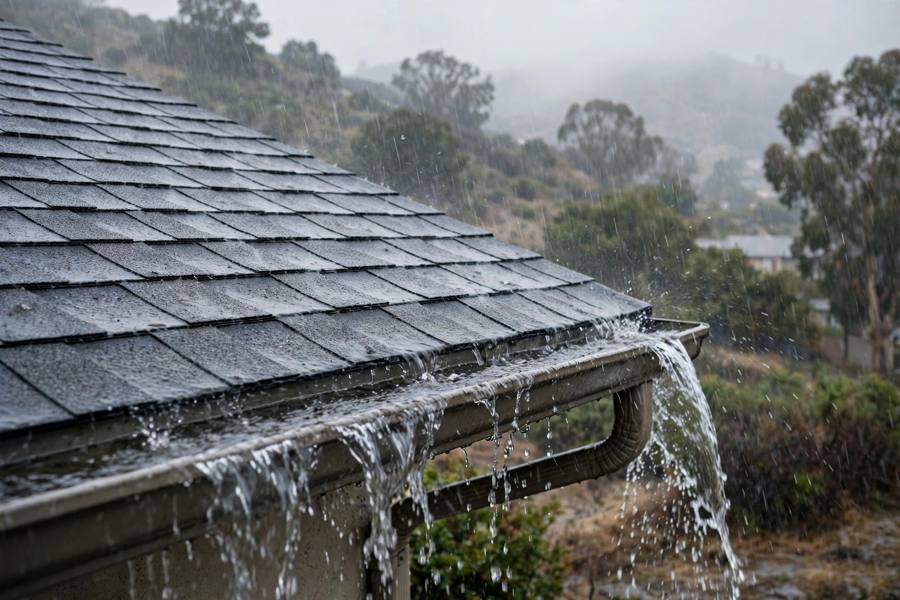
Gutters in Bell Gardens have a concentrated job: most of the year's rain arrives in a few winter months, and it has to leave the roof quickly, without backing under the eave or ponding against the foundation. A gutter system here is sized, pitched and drained for those bursts, not for an average month.
Gutter Installation in Bell Gardens: the local picture
On small lots, a downspout that discharges against a neighbour's wall or into a shared walkway is a problem, not a solution. Downspout placement on a tight Bell Gardens parcel deserves as much thought as the gutter itself.
What this service covers here: Seamless gutter installation in the length and profile the roof needs; Downspout placement that carries water away from the building, not against it; Fascia and eave condition checked before new gutters are hung.
Gutter installation is for a house with no gutters, with sagging or leaking gutters, or where a new roof is being installed and the old gutters will not survive the work.
Every gutter job starts with a measure and a written scope. The list below is what we handle as part of a standard installation. Anything outside it, like a full roof replacement or major structural repair, gets quoted separately so you can see the difference.
On-site seamless forming
We bring the roll-former to your driveway and run aluminum in one continuous piece per eave. No seams between corners means fewer leak points and a cleaner line along the roofline. Typical single-story homes need 2 to 3 hours of forming.
Hidden hangers and pitch
Hangers go in every 24 inches, screwed into sound fascia, not nailed. Each run is pitched about 1/4 inch per 10 feet toward the downspout. That pitch is what makes the water move instead of sitting in the channel and growing algae.
Downspouts and discharge
We install downspouts sized to the roof area, strap them to the wall, and route them to discharge 4 to 6 feet from the foundation. Splash blocks or extensions are included so water does not pool against the slab or in the planting beds.
Fascia and soffit repair
If the old gutter was overflowing, the wood behind it is often soft. We cut out rotted sections, splice in new material, and prime it before hanging the new run. Soffit panels damaged by years of splash-back get replaced in the same visit.
Sealing and water test
End caps, outlets, and miters get exterior-grade gutter sealant. Then we run a hose through the system and watch every joint. Any drip gets fixed before we leave. You see the test, so there is no guessing about whether it works.
Cleanup and photo record
We sweep the driveway with a nail magnet sweeper, haul off the old gutter, and send you photos of the finished runs and the downspout locations. That record is useful if you ever need to show a roofer or an inspector what was installed.
Homes and businesses.
The approach is the same for a home and a business. What changes is the access, the schedule and who needs the paperwork.
For homes
We hang seamless gutter on single-family homes, duplexes, and small multi-family buildings. Runs are formed on-site and pitched to move water away from your walls.
Rusted or leaking old gutters
Overflow at corners in storms
Downspouts dumping at the slab
For businesses
Flat commercial roofs need larger channels and scuppers than homes. We size the gutter to the roof area and route discharge away from walkways and parking.
Water pooling at the low edge
Overflow onto walkways
Undersized downspouts on flat roofs
Gutter installation Bell Gardens CA done the right way
A plain-language look at what Gutter Installation involves and when it is needed.
Gutter installation Bell Gardens CA is the trade of forming seamless aluminum or copper into long runs, hanging them on hidden hangers, and pitching every foot toward a downspout so water leaves the roof instead of soaking the fascia. We roll the gutter on-site, which means no mid-run seams to leak. Runs are typically 5-inch or 6-inch K-style, with matching downspouts sized to the roof area they drain.
Bell Gardens sits in Los Angeles County where winter rain arrives in short, heavy bursts and the summer sun bakes stucco and wood fascia until they crack. That cycle is hard on old gutters. We see clogged gutters on 1920s bungalows in Bell Gardens and rusted steel sections on homes along Eastern Avenue. A new gutter install Bell Gardens CA can end the splash-back that stains stucco and softens the soil next to your slab.
A gutter only works if it is pitched, sized, and hung on sound wood.
What it is
Seamless aluminum or copper channel formed on-site and hung along the eave to carry roof water to a downspout.
When you need it
When gutters rust through, sag, overflow at corners, or dump water at the foundation instead of away from it.
What to expect
A measure, a written scope, one to two days on site, and a hose test before the crew packs up.
How our gutter installation process runs
Every job follows the same five steps, whether it is a single run on a garage or a full house. Here is what you can expect from the first call to the final walk-through.
Call and measure We come out, walk the roofline, and measure every run with a tape and chalk line. We check the fascia for rot, note the downspout locations, and count the corners. Measure Check fascia Write scope
Fabricate on-site
On install day we bring the roll-former and run seamless aluminum in the driveway. Each piece is cut to the exact length of the eave, so there are no joints between the corners. A typical single-story home takes about 2 to 3 hours of forming before anything goes up.
Roll form
Cut to length
No seams
Hang and pitch
We set hidden hangers every 24 inches and pitch each run about 1/4 inch per 10 feet toward the downspout. Downspouts are fastened with straps, not screws driven through the face. A full house usually hangs in one day, two if we are also replacing fascia.
Set hangers
Pitch run
Strap downspouts
Seal and test
End caps, outlets, and miters get sealed with gutter sealant rated for exterior use. Then we run a hose through the system and watch every joint. If a drop shows up, we fix it before we pack up. This is the step that separates a gutter install Bell Gardens CA that lasts from one that drips.
Seal joints
Hose test
Fix drips
Walk and clean up
We walk the perimeter with you, point out the downspout discharge points, and sweep the driveway with a nail magnet sweeper. Any old gutter sections and fasteners go in the truck. You get a photo record of the finished runs and the downspout locations for your files.
Walk through
Sweep drive
Send photos
Tools and methods we use
Move across a circle, or focus it and press Enter, for an illustrative thermal view of the photograph.
Roll-former
Forms seamless aluminum gutter on-site in the driveway. Each eave gets one continuous piece, so there are no mid-run seams to leak or catch debris.
Chalk line
Marks the pitch line along the fascia before we set hangers. It is how we keep the run straight and confirm the 1/4-inch-per-10-foot fall to the downspout.
Tin snips
Cuts aluminum at outlets, end caps, and corners. Clean cuts mean the sealant has a flat surface to bond to, which is what stops corner drips.
Power drill
Drives the hidden hanger screws into the fascia and fastens downspout straps. We use it with a clutch so we do not strip the wood or over-torque the hanger.
Caulking gun
Applies exterior-grade gutter sealant at end caps, outlets, and miters. A steady bead is the difference between a joint that holds and one that drips after the first storm.
Thermal views are illustrative, generated from the photographs.
Methods
Roofing ladder
Gets us to the eave safely on single-story homes and garages. We set it on stable ground and use a standoff so the ladder does not dent the new gutter.
Nail magnet sweeper
Runs the driveway and walkway at the end of the job. It picks up stray screws and metal shavings so you are not finding them with a tire later.
Seamless on-site forming
We run the gutter in one piece per eave instead of joining 10-foot sections. Fewer joints means fewer leak points, a cleaner line, and less debris catching in the channel. It is the single biggest difference between a gutter that lasts and one that drips at every seam.
Hidden hanger spacing at 24 inches
Hangers go in every 24 inches, screwed into sound fascia. That spacing holds the run tight against the eave and resists the load of a full channel during a heavy winter rain. We replace soft fascia first so the screws have something to bite into.
Pitch to downspout at 1/4 inch per 10 feet
Every run is set with a chalk line and pitched about 1/4 inch per 10 feet toward the downspout. That is enough fall to move water without making the gutter look crooked from the street. It is also the pitch that keeps the channel from holding standing water.
Hose test before we leave
We run a hose through the finished system and watch every joint, outlet, and miter. Any drip gets sealed and re-tested. You see the test happen, so you know the system works before we pack up the truck.
When Bell Gardens homeowners call us
Rusted steel swap
A 1940s bungalow in Bell Gardens with original steel gutters that rusted through at the seams.
We tear off the old steel, repair two rotted fascia boards, and roll seamless 5-inch aluminum in a color matched to the trim. New downspouts replace the undersized originals, and we add splash blocks at each discharge point.
Outcome: The roofline looks sharp again, the side yard stays dry after rain, and the homeowner stops finding rust flakes in the flower beds.
Two-story overflow
A two-story stucco home on Eastern Avenue where the upper gutter overflows onto the lower roof during storms.
We measure the upper roof area, step up to 6-inch K-style, and add a second downspout to split the flow. The lower roof gets a new run as well so the overflow has somewhere to go instead of sheeting off the edge.
Outcome: The upper gutter now handles the volume, the lower roof stays clean, and the staining on the stucco below the eave stops getting worse.
Fourplex walkway
A rental fourplex in Bell Gardens where tenants complain about water in the walkway every winter.
We replace the shared gutter runs, enlarge the downspouts, and reroute them away from the walkway. The property manager gets photos of the finished work for the owner's records.
Outcome: The walkway stays dry, tenant complaints drop, and the owner has documentation of the new drainage layout for future maintenance.
New roof match
A homeowner on Gage Avenue who just had the roof replaced and wants gutters to match.
We coordinate with the roofing crew, hang new seamless aluminum after the drip edge is set, and match the color to the new fascia paint. Downspouts are routed to the same discharge points as before.
Outcome: The roof and gutter read as one finished system, and the homeowner avoids a second round of scaffolding and cleanup.
Flat garage edge
A flat-roof garage in Bell Gardens with water ponding at the low edge and running behind the old gutter.
We check the roof slope, set the new gutter at the true low point, and terminate the membrane edge so water drops into the channel. A wider profile handles the sheet flow off the flat section.
Outcome: Water reaches the downspout instead of running behind the gutter, and the garage wall stays dry through the rainy season.
central Bell GardensGarfield Avenue CorridorSuva School Pocket
How gutter work runs in Bell Gardens
Bell Gardens gets its rain in a short winter window, often as a few heavy storms rather than a long drizzle. That pattern matters for gutter sizing. A channel that would be fine in a wetter climate with steady rain can overflow here when an inch falls in an hour. We size for that burst. The housing stock adds its own wrinkles.
Many homes are 1920s to 1960s builds with stucco walls, shallow eaves, and fascia that has been wet and dry for decades. Pulling old gutters on these homes often reveals soft wood, so we plan for fascia repair on most jobs. On the commercial side, flat roofs along the Garfield Avenue Corridor need larger channels and scuppers, not residential K-style.
If you are comparing a gutter installation in Bell Gardens, California, ask whether the quote includes a fascia check and a hose test. Those two steps are what separate a system that lasts from one that leaks by February.
central Bell Gardens: Older commercial and residential mix with shallow eaves. We often find original wood fascia that needs repair before new hangers go in.
Garfield Avenue Corridor: A lot of flat-roof commercial buildings. These need larger gutters and scuppers sized for the roof area, not residential profiles.
Suva School Pocket: Single-story bungalows with narrow side yards. Downspout routing has to keep water out of the walkway and away from the neighbor's fence line.
Darwell / Hannon / Gallant / Asmus–Jaboneria Pocket: Homes from the 1940s and 1950s with stucco walls. We see rusted steel gutters and fascia rot from years of overflow at the corners.
Short, heavy winter rain bursts: Gutters must handle a high volume in a short window. We size up to 6-inch K-style and add downspouts when the roof area is large, rather than forcing all the flow to one outlet.
IllustrativeThe thermal view is generated from the photograph. It is not a measurement. Drag the handle, or use the arrow keys once it is focused.
Rusted steel to seamless aluminum
Before: A 1950s bungalow in Bell Gardens had original steel gutters rusted through at every seam. Water poured off the corners and soaked the fascia. The side yard had a permanent damp strip along the foundation, and the stucco showed splash stains below the eave.
After: We tore off the steel, replaced two rotted fascia boards, and rolled seamless 5-inch aluminum in a tan that matched the trim. New downspouts and splash blocks moved the discharge 5 feet from the wall. The first storm after the install, the side yard stayed dry and the stucco had no new staining.
Clear the channel twice a year, once before the rainy season and once in spring. Check the hanger screws each fall and tighten any that have backed out. Flush the downspouts with a hose to confirm flow.
Two-story overflow fixed
Before: A two-story stucco home on Eastern Avenue had a 5-inch upper gutter that overflowed onto the lower roof during every storm. The lower roof was stained, and water was tracking down the wall below the eave. The single downspout could not keep up with the upper roof area.
After: We stepped up to 6-inch K-style on the upper run and added a second downspout to split the flow. The lower roof got a new run as well. After the change, the upper gutter handled a 1-inch rain without overflowing, and the staining on the wall stopped spreading.
Inspect the upper downspouts from the ground after each big storm. Clear any debris at the outlets. Re-check the pitch on the upper run every couple of years, since two-story runs take more wind load.
Fourplex walkway stays dry
Before: A fourplex in Bell Gardens had shared gutters that overflowed into the walkway every winter. Tenants tracked mud inside, and the concrete stayed wet for days after a storm. The downspouts discharged right at the path.
After: We replaced the shared runs, enlarged the downspouts, and rerouted them to discharge into the planting beds away from the walkway. The property manager got photos of the finished work. Tenant complaints about water in the entryway dropped to zero that season.
Schedule a cleaning before the rainy season and a check after it. Clear leaves from the channel and confirm the downspout extensions are still in place. Tighten any loose hangers found during the walk-through.
Gutter problems we fix in Bell Gardens
Most gutter calls start with the same handful of symptoms. Here is what we see on Bell Gardens homes and how we handle each one.
Water at foundationWater pooling at the foundation after every stormStanding water against the slab softens the soil, stains the stucco, and can work its way into the garage or a low room. Over a few seasons it shows up as hairline cracks and a damp smell. We measure the roof area, size the gutter and downspouts to handle the runoff, and route the discharge 4 to 6 feet from the wall. If the existing downspouts are undersized, we replace them. The goal is simple: roof water leaves the property, not the slab.
Sagging guttersGutters sagging away from the fasciaA sagging run holds water in the low spot. That standing water rusts aluminum, grows algae, and pulls the hangers looser with every rain. Eventually the whole section drops off the eave. We pull the old run, check the fascia for rot, and replace any soft wood. New hidden hangers go in every 24 inches, screwed into sound material. We re-pitch the run so water moves to the downspout instead of sitting in the middle.
Corner overflowOverflow at the corners during heavy rainCorner overflow dumps a concentrated stream right at the house. It soaks the fascia, stains the stucco, and erodes the soil at the corner of the foundation. It is the most common complaint we hear after a winter storm. Corners are where seams and miters fail. We form seamless runs so there is no joint at the corner, seal the miter properly, and confirm the pitch carries water away. If the roof area is large, we add a downspout at the corner instead of forcing all the flow to one outlet.
Downspout at walkwayDownspouts dumping water at the walkwayWater discharged onto a walkway or driveway runs back toward the house, defeats the whole system, and creates a slip hazard in winter. It also stains concrete over time. We reroute downspouts to a better discharge point, add extensions or splash blocks, and where the lot allows, tie into a buried drain line. The water still leaves the roof, it just does not land where people walk.
What new gutters get you
Roof water leaves the house, not the foundation.
Foundation stays dry
Water dumped at the base of a house finds the slab edge and the soil under it. We pitch every run and extend downspouts so roof water lands 4 to 6 feet from the wall. That alone can stop the damp smell in a garage and the hairline cracks that show up after a wet winter.
Fascia stops rotting
Overflowing gutters soak the fascia board behind them. Once that wood rots, the gutter has nothing solid to hang on. We replace damaged fascia during the job and fasten new hangers into sound wood, so the run stays tight and level through the next rainy season.
No more trenching
A clogged or undersized gutter sends a sheet of water off the roof edge. That water carves a trench through landscaping and pools against the stem wall. A correctly sized gutter install Bell Gardens CA moves the same volume through a downspout and away from the planting beds.
Curb appeal that reads
New seamless aluminum in a color matched to your trim sharpens the roofline. We stock the common Bell Gardens palettes, from sand and tan to dark bronze. It is a small change that makes a 1940s bungalow look maintained instead of tired.
What you receive
Clear records you can keep and share.
Written scope
Profile, color, and downspout count
Photo record
Finished runs and discharge points
Layout notes
Where each downspout lands
Maintenance sheet
Cleaning and check schedule
Seamless versus sectional gutter
The main choice on a Bell Gardens home is whether the gutter is formed in one piece or assembled from short sections.
Seamless
Formed on-site in one piece per eave
No mid-run seams
Cleaner roofline
Fewer leak points
Sectional
Pre-cut lengths joined at seams
Seams every few feet
More leak points
Cheaper material cost
Half-round
Curved profile, often copper
Classic look
Higher material cost
Fits older homes
What we work with
Aluminum
Copper
K-style
Half-round
Downspouts
Splash blocks
Sealant
Hangers
Service ZIP codes.
Bell Gardens, CA 90201. Not listed? Call and ask: it only takes a minute.
Gutter installation questions we hear on the phone
Copper roughly doubles the material cost. We give you a written number after we measure, not a phone guess.
Seamless 5-inch K-style aluminum is the right call for most Bell Gardens roofs. It handles the short, heavy winter rain we get in Los Angeles County and holds up to the summer sun without rusting. If your home has a steep tile roof or a lot of runoff, we step up to 6-inch. Copper is a good fit on older bungalows where you want the look to match the era.
We do. We roll seamless gutter on-site, handle fascia and soffit repair, and install downspouts. Call +1 (424) 336-0888 and we will set a time to measure.
A single-story home is usually a one-day job, about 4 to 6 hours. Two-story homes or jobs with fascia repair run into a second day. We form the gutter in the morning and hang it in the afternoon. If rain is in the forecast, we tarp the exposed fascia overnight so nothing gets wet behind the new run.
Get your gutter installation Bell Gardens CA estimate
We measure the roofline, check the fascia, and leave you a written scope with the profile, color, and downspout count. Call +1 (424) 336-0888 and we will set a time that works for you.